
How to quantify dopamine: workflows, pitfalls, and validation checklist
February 19, 2026 2026-02-20 17:25How to quantify dopamine: workflows, pitfalls, and validation checklist
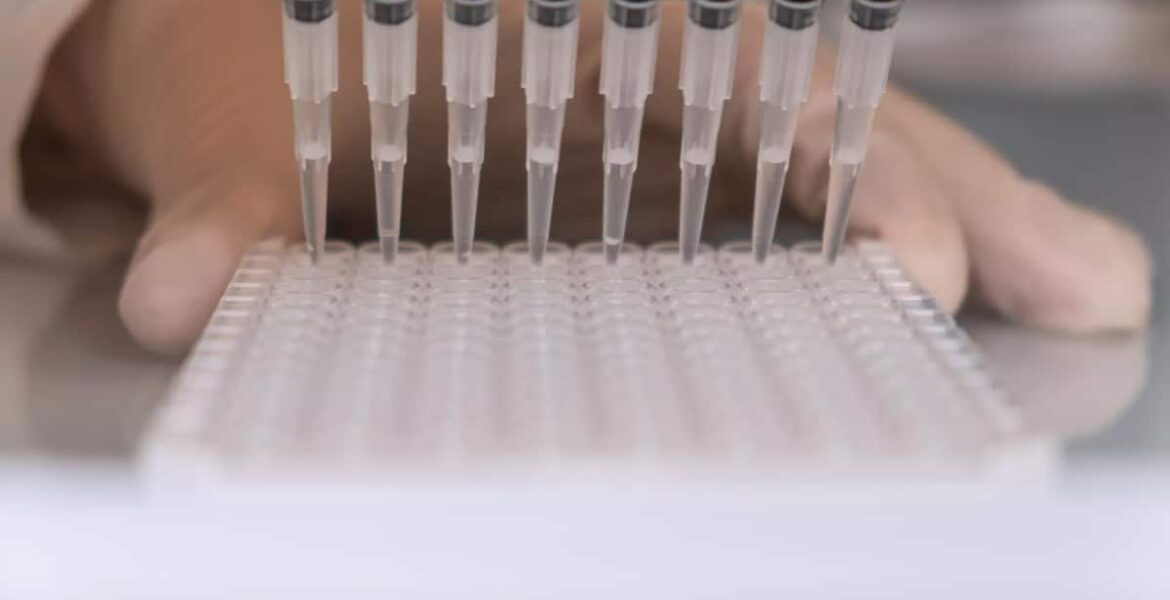
How to quantify dopamine: workflows, pitfalls, and validation checklist
How to quantify dopamine reliably? The answer depends on three things: pre-analytics, matrix complexity, and method selection. Because dopamine is an oxidizable catecholamine, inadequate sample handling (collection, stabilization, storage) can quickly lead to signal loss, artefacts, or inconsistent results—even when using high-end analytical platforms.
At Immusmol, we have supported clients quantifying dopamine across a wide range of matrices over the past 10 years—from human plasma and urine, to dopamine release assays in brain organoid supernatants, and even whole-animal homogenates. Our dopamine ELISA workflows are referenced in nearly 50 peer-reviewed publications, giving us a broad view of what typically works—and what commonly fails—across sample types and study designs.
In this article, you’ll find a practical decision framework to choose between dopamine ELISA, LC-MS/MS, and HPLC-ECD, plus concrete guidance to control pre-analytical variables, reduce matrix interference, and document performance using a validation checklist.
This guide applies to dopamine quantification in plasma, urine, CSF, tissue/whole-animal homogenates, and organoid or cell-culture supernatants, and includes:
1) Choose your dopamine method: ELISA vs LC-MS/MS vs HPLC-ECD
The best dopamine quantification method is rarely “one-size-fits-all.” In practice, the choice depends on three variables:
Instrumentation and in-house expertise
Do you already run LC-MS/MS routinely? Do you have a validated HPLC-ECD setup for monoamines? Or do you need a workflow that can be implemented with standard plate-reading equipment (dopamine ELISA)?
Study context and expectations
A discovery research project may prioritize throughput and practicality, while a clinical or late-stage translational setting may prioritize standardization, traceability, cross-site reproducibility, and methods that your organization already considers “conventional” for decision-making.
Analytical needs
Are you measuring dopamine alone, or do you need multiple analytes in the same run (e.g., catecholamines and metabolites)? What is your expected concentration range, and how challenging is your matrix (plasma, urine, CSF, tissue homogenate, organoid/cell culture supernatant)?
When LC-MS/MS is the best fit
Choose LC-MS/MS when you need:
- High analytical specificity (helpful when matrices are complex or interferences are a concern)
- Multi-analyte quantification in one method (dopamine plus related catecholamines/metabolites, depending on your panel)
- A method that can be built into a fit-for-purpose or regulated validation framework
Trade-offs:
- Requires specialized instrumentation, method development, maintenance, and trained operators
- Sample preparation can be time-consuming (often the limiting step for robustness)
When HPLC-ECD is the best fit
Choose HPLC-ECD when you:
- Already have an established electrochemical detection workflow for monoamines/catecholamines
- Need a conventional neurochemistry approach that can be very sensitive for electroactive compounds
- Want to measure dopamine and other electroactive analytes in a single chromatographic run (method-dependent)
Trade-offs:
- Specificity depends heavily on chromatographic separation and system stability
- Can be sensitive to co-eluting interferences if cleanup/separation isn’t optimized
When a dopamine ELISA workflow is the best fit
A dopamine ELISA workflow is often the best choice when:
- you need plate-based throughput to screen large cohorts
- a standardized protocol that’s easy to deploy across teams
- LC instrumentation/expertise isn’t readily available.
It’s also a strong fit for dopamine release assays in low-volume samples (e.g., cell culture/organoid supernatants, microdialysates) and routine quantification in clinical-type matrices such as plasma and urine.
What’s important is to match the kit format to your constraints:
- Very low sample volume / challenging matrices (research use):
If sample is precious (organoids, microdialysis, small animal work, homogenates) or dopamine levels are expected to be low, prioritize ultra-sensitive formats that support minimal sample volumes down to 1 µL, with extraction workflows designed for catecholamines.
- Clinical-lab style workflows:
If your context requires a more “conventional” approach for clinical settings, select an IVD dopamine ELISA kit. For example, fast-track plasma/urine ELISA workflows are positioned for in vitro diagnostics & research use, with defined minimal input volumes (e.g., urine 10 µL, plasma 300 µL) and short turnaround (~5h for the 3-analyte format). - Need dopamine + norepinephrine + epinephrine in the same study (multiplex catecholamines):
If you want to quantify dopamine, norepinephrine (noradrenaline), and epinephrine (adrenaline) together—either to save sample, reduce batch effects, or support multi-analyte interpretation—Immusmol offers 3-catecholamine ELISA formats:
– An ultra-sensitive 3-catecholamine “any sample” kit (research use) with LOD reported at 6.6 pg/mL and minimal sample volume as low as 1 µL.
– A fast 3-catecholamine plasma/urine kit (RUO or IVD) with stated performance ranges and sensitivities for each analyte, designed for completion within ~5 hours.
Quick context: Immusmol’s Dopamine ELISA kits
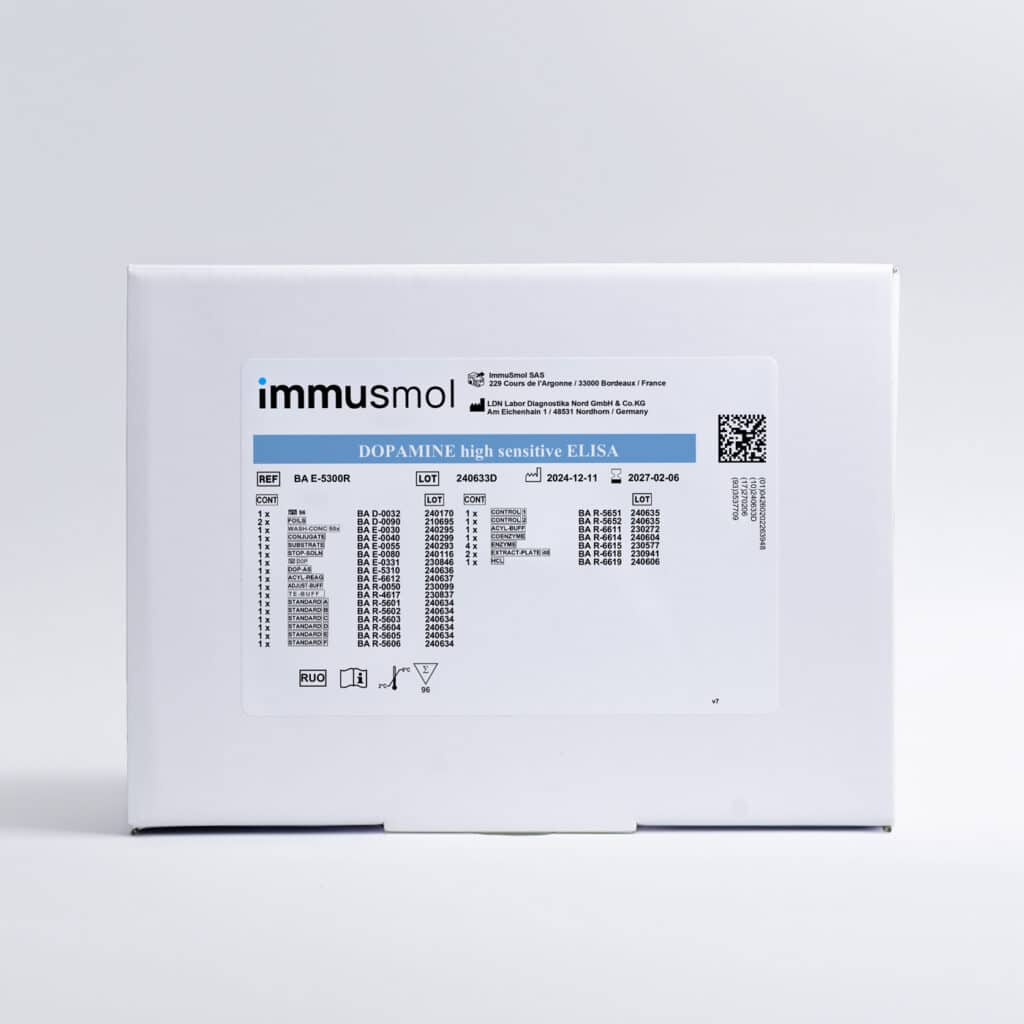
- Samples: any species, any sample type, including homogenates & supernatants
- LOD/sensitivity: 3.3 pg/mL
- Range: 0.5–80 ng/mL,
- Minimal sample volume: 1 µL
- Assay time: Overnight
- Citations: 40+ papers
- Intended use: Research use only
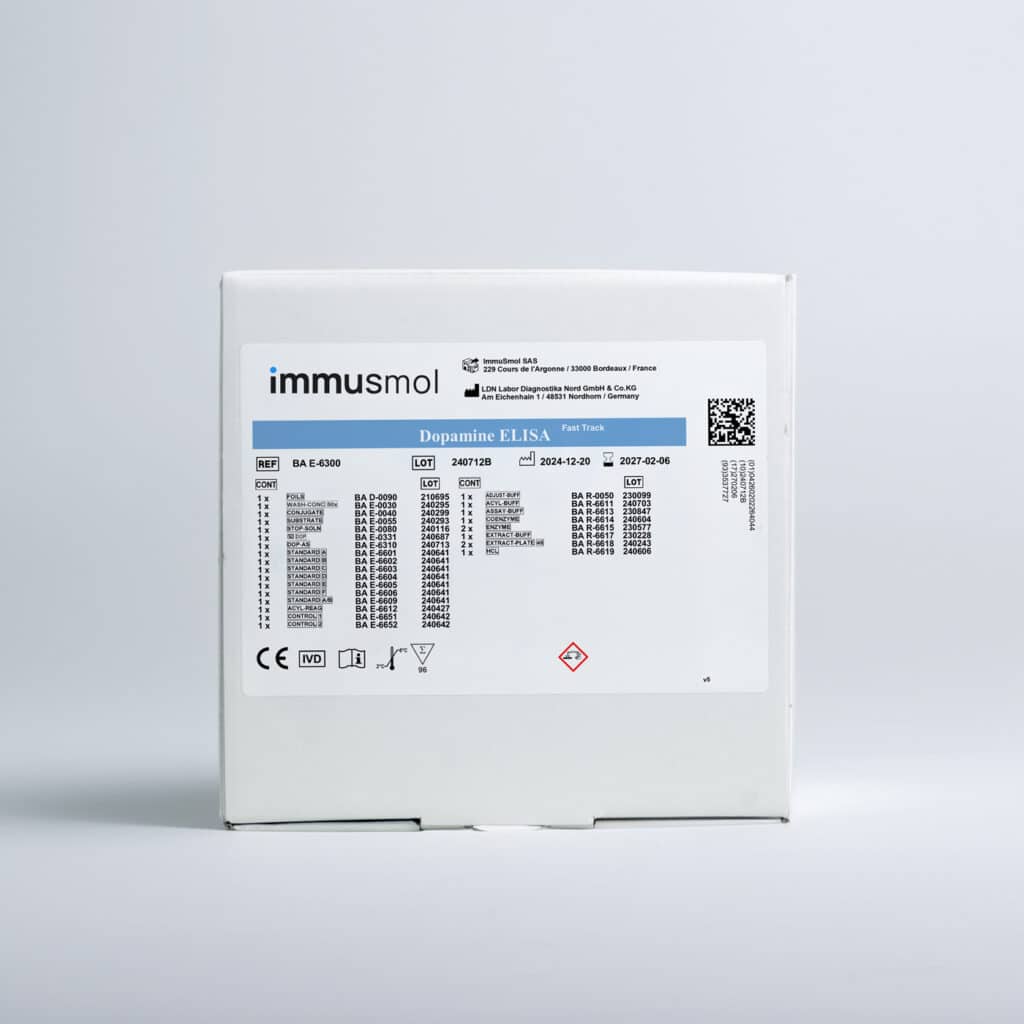
- Samples: urine & plasma from any species
- LOD/sensitivity: plasma 25 pg/mL; urine sensitivity 4.5 ng/mL.
- Range: 0 / 4.5 – 2 000 ng/mL
- Minimal sample volume: urine 10 µL; plasma 300 µL
- Assay time: 4h
- Intended use: RUO or IVD (EU only)
2) The most common pitfalls (and how to avoid them)
Whatever the method chosen, most issues in dopamine quantification come from the pre-analytical phase—sample collection, stabilization, storage, and early processing. If these steps aren’t controlled, you can see signal loss, artefacts, or inconsistent results even with high-end analytical platforms.
Pitfall 1 — haemolysis / lipemia and dirty matrices
When working with plasma dopamine, one of the most common causes of inconsistent results is simply the matrix quality: samples that are hemolyzed (pink/red), lipemic (milky/turbid), or otherwise “dirty” can shift dopamine measurements even when the assay itself is performing well.
Dopamine is an oxidizable catecholamine, so small changes in matrix composition can accelerate oxidation and alter what you measure.
Hemolysis can bias dopamine quantification in two dopamine-relevant ways:
- Oxidation chemistry: hemolysis releases heme/iron-containing components into plasma. Because iron can catalyze dopamine oxidation, hemolyzed samples can increase dopamine loss or conversion to oxidized products during handling—especially if stabilization timing varies.
- ELISA optical interference: hemoglobin increases background absorbance and can distort ~450 nm reads, shifting calculated concentrations in colorimetric ELISAs.
Lipemia can skew results differently:
- ELISA readout distortion: turbidity increases light scattering, making OD readings less stable and more variable across samples.
- LC-MS/MS matrix effects: lipid-rich plasma (phospholipids) is a common driver of ion suppression/enhancement, reducing dopamine response unless cleanup and internal standards are robust.
Practical mitigations
- Define and document rejection criteria (visible hemolysis/lipemia) or use hemolysis/lipemia indices when available.
- If borderline samples must be included, prove performance in that matrix: spike-and-recovery + dilution linearity/parallelism using hemolyzed/lipemic material (matrix-matched QC pools help).
- For LC-MS/MS, plan phospholipid-aware cleanup/separation and monitor matrix effects (stable isotope internal standards are ideal).
Pitfall 2 — degradation during collection and storage
In dopamine quantification projects—especially with plasma, organoid/cell-culture supernatants, and tissue homogenates—the most common reason for “unexpectedly low dopamine” is simple: dopamine starts degrading before the assay even begins. Because dopamine is an oxidizable catecholamine, losses during collection, storage, and early processing create an error that no ELISA, LC-MS/MS, or HPLC-ECD method can undo.
That’s why many catecholamine workflows include antioxidant preservation as early as possible (typically immediately after collection, or during homogenization). Two additives are widely used because they address the main chemical drivers of dopamine loss:
- EDTA (metal chelator): trace metals such as iron and copper can catalyze oxidation. EDTA chelates these metals and reduces metal-driven dopamine oxidation during handling.
- Sodium metabisulfite (antioxidant/reducing agent): sulfites help limit oxidative degradation by acting as an antioxidant/reductant in solution, which is why sodium metabisulfite is commonly cited in catecholamine preservation guidance and evaluated in stability studies.
You’ll also see this principle reflected in clinical pre-analytics for plasma catecholamines, where EDTA–metabisulfite tubes and strict cold-chain handling are specified.
Recommendations
- Plasma & homogenates: use EDTA + an antioxidant after sample collection (or in the homogenization buffer for tissues) to stabilize dopamine during processing and storage.
- For release assays (organoids/cells), avoid adding these reagents to living cultures before the collection window—add them to the collected supernatant instead to prevent confounding biology.
Practical takeaway
Preservatives help, but they don’t replace good pre-analytics:
- Keep samples cold
- Minimize time-to-processing
- freeze for longer storage
- protect from light when relevant
- limit freeze–thaw cycles.
Pitfall 3 — pH and acid carryover breaking extraction
In practice, one of the most frequent “mysterious low dopamine” issues we see is not the detector (ELISA, LC-MS/MS, or HPLC-ECD), but the extraction step—especially when a workflow relies on boronate-affinity capture and samples were acidified for stabilization.
Why boronate is used (and why it helps): boronate ligands are popular in dopamine and catecholamine workflows because they selectively bind catechol (cis-diol) structures—dopamine, noradrenaline, adrenaline—via a reversible boronate–diol interaction. This provides a practical way to enrich catecholamines and remove matrix components that drive interference (salts, proteins, pigments), improving robustness for both immunoassays and LC/HPLC methods.
Why pH control is critical: the boronate–catechol binding is strongly pH-dependent. Capture is favored under neutral to alkaline conditions (boronate form), while acidic conditions reduce binding, lowering recovery. So if an acidified sample carries too much acid into the extraction step (or the buffer capacity is insufficient), the extraction mixture may never reach the required pH, and dopamine simply won’t bind efficiently—leading to artificially low concentrations and higher variability.
Fixes:
- Neutralize appropriately before boronate capture if samples were acidified (don’t rely on “it’ll buffer out”).
- Standardize acidification across all samples (acid type, concentration, timing) and record it—small differences can shift extraction pH and recovery.
- Add a quick spike-and-recovery checkpoint at the extraction step: if recovery collapses when pH drifts, you’ve found the root cause fast.
Pitfall 4 — “cis-diol” interferences reducing dopamine recovery
A scenario we see a lot is dopamine release measurements in cell culture or brain organoid supernatants: everything looks fine on paper, but dopamine comes out unexpectedly low or inconsistent—often when samples are collected in high-glucose / sugar-rich media (or media with other polyols).
Why it happens: many dopamine ELISA workflows (and some LC/HPLC prep workflows) use boronate-affinity extraction to selectively capture catecholamines before detection. Boronate ligands don’t “recognize dopamine” specifically—they bind cis-diol (catechol-like) structures in general. Dopamine has that catechol motif, but so do many sugars and sugar-like compounds (and some additives). In sugar-rich matrices, these cis-diol molecules can compete for the same boronate binding sites, lowering dopamine capture and therefore reducing recovery (and sometimes increasing variability across different media lots).
What it looks like in data
- Low spike recovery (your dopamine spike doesn’t come back at the expected level)
- Non-parallel dilution (dilution doesn’t “fix” the concentration cleanly)
- Big differences between media lots or between “fresh” vs “conditioned” media
Fixes:
- Prove it early with spike-and-recovery in your exact matrix
– Run a quick panel: neat matrix + diluted matrix + different lots.
– Do this before running a big study—this is the fastest way to confirm competition effects. - Reduce competing cis-diols at the collection step (best fix when possible)
– For release experiments, consider a short wash + incubation in a low-sugar buffer/medium during the collection window (if compatible with your biology).
– If you must collect in rich medium, consider diluting with the extraction/binding buffer to reduce competitor concentration (but keep your expected dopamine within range). - Increase extraction “capacity” when samples are hard to change
– Use more binding capacity (when the workflow allows), or split the sample across two extractions and pool eluates.
– Keep pH in the optimal binding range for boronate capture (competition is worse when binding conditions are marginal). - Use matrix-aware quantification when interference can’t be eliminated
– Apply matrix-matched calibration or standard addition (especially for difficult media).
– Document the approach in your methods—this is a common way to make “messy matrix” results publishable.
Pitfall 5 — Volume inconsistency and pipetting errors
When a dopamine workflow allows flexible sample input volumes, you need to lock a volume strategy—but just as important is how accurately you pipette it. With dopamine, small handling differences can quickly show up as inconsistent replicates because you’re often working near the lower end of the assay range and the workflow includes multiple preparation steps (extraction, derivatization/conversion, transfers).
Two problems typically drive this pitfall:
- Mixing different sample volumes within the same run
Some workflows require all samples in a run/plate to use the same starting volume (because volumes influence extraction conditions, reagent ratios, and back-calculation). If you mix volumes, you can introduce systematic bias across wells. - Inadequate sampling and poor pipetting practice
Even when you choose one volume, inaccurate pipetting can create variability that looks like “biology” but is actually technique:
– Under- / over- delivery at low microliter volumes (especially <10 µL)
– Inconsistent pre-wetting and tip immersion depth
– Bubbles, droplet retention on tips, or incomplete dispensing
– Insufficient mixing (dopamine can be heterogeneous in dirty matrices or after precipitation/extraction)
– Timing differences between wells/rows (edge effects and reaction timing)
Fixes:
- Pick one starting volume per matrix and keep it constant for the entire plate/run. If you need different volumes (e.g., different matrices), split into separate runs.
- Use the right tools for small volumes: calibrated pipettes, low-retention tips, and (when possible) repeat pipettors or multichannel for consistency.
- Standardize technique: pre-wet tips, avoid bubbles, keep consistent immersion depth, and mix the sample the same way every time (especially after thawing or extraction steps).
- If you’re seeing high CVs, do a quick “pipetting sanity check”: pipette a dye or gravimetric check at your working volume to confirm actual delivery.
Pitfall 6 — Temperature drift and edge effects (especially ELISA)
If your dopamine workflow includes a long incubation (e.g., ELISA, overnight steps), be cautious: small temperature gradients, airflow, or evaporation across a plate can create edge effects and signal drift that inflate CVs and bias concentrations.
Fix: incubate in a temperature-controlled environment, seal plates consistently, avoid placing plates near doors/vents/fans, and standardize timing across wells (multichannel/automation helps). If edge effects persist, consider reserving perimeter wells for blanks/controls.
3) If you choose ELISA for dopamine quantification: what to do (and what to avoid)
Not all dopamine ELISA kits perform equally across matrices and concentration ranges. Before committing to a study, it’s worth applying a few quick “go/no-go” checks to avoid assays that lack the sensitivity, chemistry, or validation package needed for reliable dopamine quantification.
Anticipate your dopamine levels and choose the right ELISA kit format
Before picking a dopamine ELISA, estimate your expected concentration range, sample volume, and matrix complexity (plasma/urine vs CSF, tissue homogenates, organoid/cell-culture supernatants). The right kit is the one that matches your reality.
If you need very low dopamine concentrations, low-volume samples, or unusual matrices (homogenates, CSF, supernatants):
Consider the Ultra-Sensitive Dopamine ELISA kit (BA-E-5300R):
- Any species, any biological sample (including homogenates/supernatants)
- Minimal sample volume: as low as 1 µL (up to 750 µL possible for dilute samples)
- High sensitivity: LOD 3.3 pg/mL, range 0.5–80 ng/mL
- Workflow includes extraction + acylation/conversion steps, with an overnight incubation
- Literature use: listed as cited in 40+ papers (product page / datasheet)
If you focus on plasma/urine, want faster turnaround, and need an IVD option
Consider the Fast Dopamine ELISA kit (BA-E-6300):
- Validated for urine and plasma, reacts with all species
- Assay time: ~4h
- Minimal sample volume: urine 10 µL, plasma 300 µL
- Range: 4.5–2000 ng/mL (with sensitivity urine 4.5 ng/mL; plasma 25 pg/mL)
- Regulatory positioning: RUO or IVD (EU-only)
- Literature use: page lists 7 citations (human/mouse/rat, plasma/urine)
If you want dopamine + norepinephrine + epinephrine in the same study (multiplex catecholamines):
- 3 Catecholamines ELISA kit – Any sample (BA-E-5600R) (ultra-sensitive, low-volume, broad matrices): LOD 6.6 pg/mL, minimal sample volume as low as 1 µL
- Fast 3 Catecholamines ELISA kit – Plasma & Urine (BA-E-6600) (rapid, clinical-type matrices): ~5h workflow, IVD + RUO positioning, cited in 9 papers (per datasheet)
Lock down pre-analytics (this is where most dopamine ELISA problems start)
Whatever ELISA you choose, dopamine is an oxidizable catecholamine, so results are often won or lost before the plate is even opened.
Practical rules to standardize:
- Stabilize immediately after collection when relevant (e.g., EDTA + antioxidant strategy is commonly recommended for dopamine stability; add to collected supernatants rather than live cultures).
- Keep cold-chain consistent: minimize time at room temperature; freeze for longer storage; track freeze–thaw history.
- Reject or flag poor-quality plasma: hemolyzed/lipemic samples can bias dopamine readouts (optical and/or chemical matrix effects).
- If your workflow includes boronate-based extraction, ensure extraction conditions are correct (pH/buffer capacity; avoid acid carryover and confirm recovery in your matrix).
- For long incubations, control temperature uniformity and avoid edge effects (plate placement, sealing, airflow).
Red flags: when to dismiss (or at least challenge) a dopamine ELISA kit
When comparing dopamine ELISA kits, these are the most common “looks fine until it fails” issues:
A) Sensitivity and range don’t match your biology
- If the LOD/LLOQ is above your expected levels (common in plasma/CSF or low-release models), the kit will look noisy and underpowered.
- If required sample volume is unrealistic for your model (organoids, microdialysis, rare CSF), move on.
B) The immunochemistry doesn’t fit small-molecule reality
- Dopamine is a small molecule, so most reliable ELISAs are competitive (not sandwich-style). If a kit is not clearly competitive, ask for the assay principle and validation data.
- If a kit claims no derivatization/acylation/conversion steps, don’t assume it’s “better” or “simpler”—instead, verify (with data) that sensitivity, specificity, and matrix robustness are still adequate for dopamine.
C) No clear pre-analytics + QC + validation package
Dismiss (or be very cautious with) kits that don’t provide:
- Clear sample handling/stabilization guidance (plasma tube type, urine conditions, storage windows, freeze–thaw limits)
- Specificity / cross-reactivity information vs dopamine analogs and related metabolites (essential for catecholamine work)
- Practical performance checks you can run in your matrix:
- Calibration curve acceptance + in-run controls
- Spike recovery, dilution linearity/parallelism
- Stability (bench, freeze–thaw, long-term)
4) Frequently asked questions
It depends on your instrumentation, expertise, matrix, and whether you need multi-analyte profiling. LC-MS/MS is often preferred for maximum analytical specificity and multiplexing, HPLC-ECD is a classic option in neurochemistry for electroactive analytes, and dopamine ELISA is a practical choice for standardized, plate-based throughput when pre-analytics and matrix handling are well controlled.
Dopamine is an oxidizable catecholamine, so it can degrade or transform during collection, stabilization, storage, and early processing. Variability in time-to-freeze, temperature, and matrix quality often explains inconsistent dopamine results more than the detection platform itself.
The principle applies to any aqueous matrix where dopamine can oxidize (plasma, urine, CSF, tissue/brain homogenates, organoid/cell supernatants). A common approach is to add chelators (e.g., EDTA) and antioxidants/reductants immediately after collection (or in homogenization buffer). For release assays, avoid adding these reagents to living cultures before the collection window—add them to the collected supernatant instead.
Stability depends on matrix, temperature, preservatives, and storage time. As a rule, dopamine is least stable at room temperature, more stable on ice/4°C short term, and best preserved frozen for longer-term storage—especially when freeze–thaw cycles are minimized and stabilization is standardized.
Yes. Hemolyzed plasma can bias dopamine measurement by changing matrix chemistry (including oxidation risk) and, for ELISA, by adding optical interference. Lipemic plasma can increase turbidity (affecting ELISA OD reads) and can drive LC-MS/MS matrix effects (ion suppression/enhancement) unless cleanup/internal standards are robust.
Boronate chemistry can selectively capture catechol (cis-diol) structures (like dopamine and other catecholamines), helping enrich analyte and remove matrix components that cause interference. This cleanup step can improve robustness in complex samples—provided the binding conditions are correct.
Boronate–catechol binding is pH-dependent and typically requires neutral to alkaline conditions to bind efficiently. Acid carryover (e.g., from acidified samples) can lower pH during extraction, reduce binding, and lead to low dopamine recovery. If you acidify samples, standardize it and ensure appropriate neutralization/buffer capacity before extraction.
It can. Many sugars and polyols contain cis-diol structures that can compete with dopamine for boronate binding sites, reducing recovery and increasing lot-to-lot variability. The fastest way to detect this is a spike-and-recovery check in your exact medium (including the same lot and supplements).
Low spike recovery usually indicates matrix interference, extraction issues, pH problems, or competing compounds rather than “true low dopamine.” Troubleshoot by (i) checking pH/extraction conditions, (ii) testing dilution series for parallelism, (iii) comparing matrices/lots, and (iv) running spiked controls through the full workflow to localize where recovery is lost.
Many robust small-molecule assays rely on competitive formats and may include derivatization/acylation or conversion steps to improve sensitivity, specificity, and matrix robustness. “No derivatization” isn’t automatically better—what matters is whether the kit demonstrates reliable performance (LOD/LLOQ, recovery, linearity, selectivity) in your matrix.
Common causes are pipetting accuracy, insufficient mixing, inconsistent timing across wells, bubbles, or temperature/edge effects during long incubations. For low-level dopamine, small volumetric errors can translate into large concentration differences. Lock sample volume strategy per plate, standardize technique, and control incubation conditions.
At minimum, run fit-for-purpose checks in your exact matrix: (1) spike recovery (low/med/high), (2) dilution linearity/parallelism on endogenous samples, (3) intra/inter-run precision (CV), and (4) stability (bench + freeze–thaw + storage). Also define run acceptance criteria (curve + in-run QCs) before analyzing the full cohort.