
Plasma Histidine Emerges as a Potential Biomarker of Cancer Immunotherapy Outcomes
September 25, 2026 2026-09-25 10:09Plasma Histidine Emerges as a Potential Biomarker of Cancer Immunotherapy Outcomes
Plasma Histidine Emerges as a Potential Biomarker of Cancer Immunotherapy Outcomes
A new Nature Medicine study identifies plasma histidine as a metabolic feature associated with favorable outcomes after cancer immunotherapy. It also makes the case for accessible, quantitative tools to measure L-histidine in preclinical and clinical research.
Immune checkpoint inhibitors (ICIs) have transformed oncology, but only a subset of patients achieve durable responses. Finding biomarkers that help characterize response and resistance remains a major priority, and metabolism is increasingly part of that search.
In “Metabolic determinants of cancer immunotherapy outcomes identified by plasma profiling”, Suissa and colleagues, working with teams at Gustave Roussy and CentraleSupélec, used large-scale longitudinal metabolomics to show that plasma histidine is one of the circulating metabolites most consistently associated with favorable immunotherapy outcomes. Their data suggest histidine may be both a circulating biomarker and a modulator of antitumor immunity.
Plasma histidine stands out in a large multicohort metabolomic analysis
The study is one of the largest longitudinal metabolomic analyses of immunotherapy response to date. The researchers profiled 4,336 plasma samples from 1,714 patients, covering five tumor types and 16 cohorts across Europe and North America, under several ICI-based treatment modalities, including fecal microbiota transplantation.
A machine-learning framework integrating longitudinal measurements of 154 metabolites with clinical variables selected a compact signature predictive of 12-month progression-free survival (PFS). It reached an AUC of 0.88 in training and 0.73 in an independent validation cohort. Histidine emerged as the dominant predictor in the selected model, with consistently high variable importance across model iterations.
The association held in external cohorts:
- IML1–SABR: higher baseline plasma histidine was associated with prolonged PFS and overall survival (OS).
- AtezoTRIBE (metastatic colorectal cancer): higher histidine was associated with longer OS.
- MIND-DC (stage III melanoma): higher histidine was associated with improved recurrence-free survival in the dendritic-cell vaccine arm, but not in the placebo arm.
- PRIMM (stage III–IV melanoma): high histidine before and shortly after ICI initiation was associated with PFS of 12 months or longer.
- CheckMate-025 (phase III, metastatic renal cell carcinoma): higher baseline histidine was associated with better PFS and OS in multivariable analyses. A significant interaction with treatment arm (nivolumab vs everolimus) suggests histidine may carry predictive, not only prognostic, information.
Histidine dynamics during treatment
The investigators also followed histidine over time. In the cohorts analyzed longitudinally, responders showed rising circulating histidine levels during treatment. This suggests that histidine trajectories, not only a single baseline value, may be informative in translational immunotherapy research.
From biomarker association to biological function
The study went beyond clinical association. In mouse fibrosarcoma and melanoma models, oral L-histidine accelerated tumor rejection induced by immune checkpoint blockade. When given before tumor implantation, it delayed tumor establishment. The authors tracked plasma and intratumoral histidine by mass spectrometry to confirm that supplementation raised circulating levels.
In vitro experiments on murine CD8+ T cells suggested a mechanism. Histidine increased mitochondrial respiration through fatty-acid oxidation and preserved proliferative capacity under repeated T-cell receptor stimulation, a model of exhaustion-associated dysfunction.
Diet is only part of the story. In a lung cancer cohort, histidine intake, but not plasma histidine, was associated with PFS, and the authors link this to gut microbes that degrade histidine. Histidine-rich diets were associated with improved outcomes mainly in patients without these dysbiotic signatures.
The authors stress that prospective clinical studies will be needed to establish the prognostic relevance and therapeutic potential of histidine. They recommend monitoring plasma histidine in any future supplementation study.
Why absolute quantification of plasma histidine matters
The study relied on targeted mass spectrometry-based metabolomics, a powerful approach for broad metabolic discovery. Like most discovery metabolomics, it reported histidine as relative abundance, and patients were stratified at cohort-specific medians. There is not yet an absolute histidine concentration that defines “high” or “low”.
Once a metabolite has emerged as a candidate biomarker, the next steps usually require absolute, comparable concentrations across many samples, for example:
- validating histidine changes in independent cohorts;
- monitoring longitudinal plasma samples during treatment;
- measuring histidine in preclinical supplementation or intervention studies;
- comparing circulating histidine between experimental groups;
- incorporating histidine into focused translational biomarker programs.
A quantitative ELISA complements metabolomic discovery in exactly these settings.
A quantitative L-Histidine ELISA for preclinical and clinical research
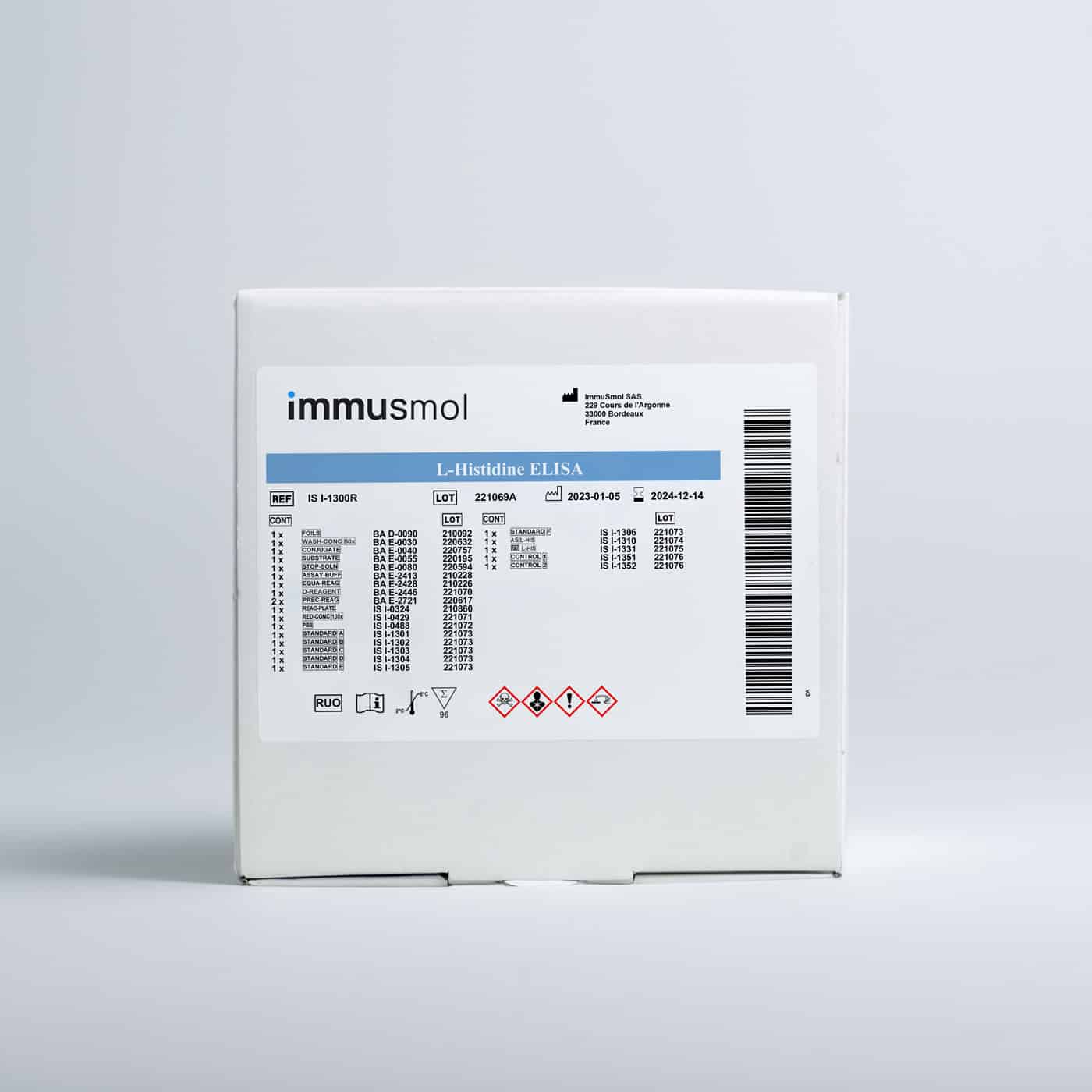
The ImmuSmol L-Histidine ELISA Kit (IS-I-1300R) measures L-histidine concentrations in plasma.
Because L-histidine is the same molecule in every species, the assay is not species-restricted. The same kit can be used for mouse intervention studies and for human cohort samples, so the metabolite is measured the same way as a program moves from preclinical models toward the clinic.
| Feature | L-Histidine ELISA IS-I-1300R |
|---|---|
| Sample | Plasma |
| Sample volume | 10 µL |
| Analytical sensitivity | 1.4 µM |
| Measurement range | 5.3–390 µM |
| Format | 96-well ELISA |
| Species | Any species (conserved analyte) |
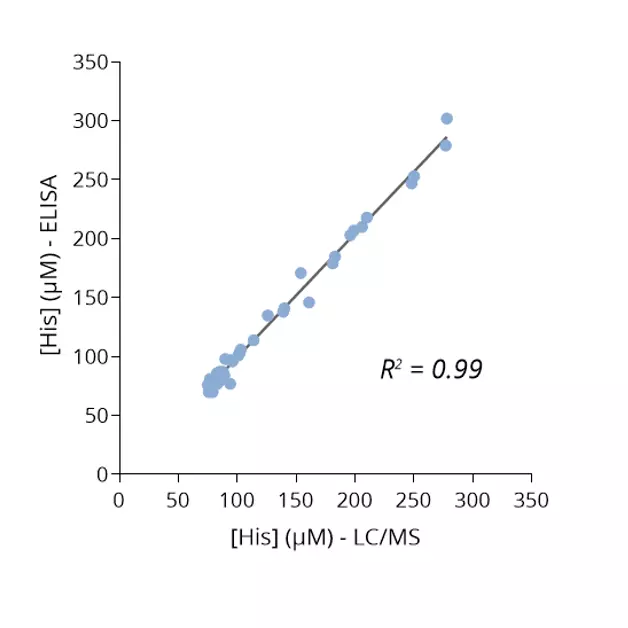
| Validation | Cross-validated against LC-MS in human plasma (R² = 0.990) |
In a cross-validation experiment on plasma from healthy human donors, L-histidine concentrations measured with the ImmuSmol ELISA correlated with LC-MS measurements with an R² of 0.990.
The low sample requirement matters for precious longitudinal clinical specimens and for serial bleeds in mice. For comparison, the mass spectrometry protocol in the study used 50 µL of human plasma and 25 µL of murine plasma per sample.
From metabolomic discovery to targeted biomarker validation
Studies such as Suissa et al. show how metabolomic profiling can reveal overlooked links between circulating metabolites and immunotherapy response. They also raise the next translational question: how can these candidate biomarkers be measured efficiently across larger series, longitudinal cohorts and preclinical models?
Mass spectrometry remains invaluable for discovery and multiplex metabolomics. Once the question narrows to a single metabolite such as L-histidine, a targeted ELISA offers a practical complement. The ImmuSmol L-Histidine ELISA combines a 10 µL plasma requirement, use across species and LC-MS cross-validation to support histidine research from mouse models to human cohorts.
